ABSTRACT
In this research paper, the possible aerodynamic positives through technoligies adapted from Formula 1 can benefit cars. Through wind tunnel and Computational Fluid Dynamic test the model cars exhibited the negatives and positives shown through the adaptation of a specific Formula 1 technology, a front wing. Through these tests possible future implications on the car industry were discovered. Furthermore, the paper discusses the advantages from both a physics standpoint and a business one. Physics aside, the economic and business oriented discussion was prompted by the results. Possible future implications as a result of this research and research alike is vast and this paper makes it clear that it is one which undoubtedly requires more research.
Introduction
Without a doubt Formula 1 is one of the most thrilling and captivating sports in the world. It is a sport that hosts events on almost every continent, including South America, North America, Europe, Asia, and Australia. These events con sist of three days, Friday, Saturday, and Sunday, of high-speed cars equipped with the most advanced and cutting edge technology. The popularity of these events is no secret, as shown by the average three-day attendance of over 200,000 guests. This number does not include the many fans who enjoy watching the spectacle from afar, with a cumulative TV audience in 2019 of 1.9 billion people. (Shields & Reavis, 2020).
Formula 1 has always been the highest class of single-seater, open-cockpit cars since its inception in the 1920s and 1930s, thus its success isn’t a new phenomenon. However, single-seater racing, during its early days, com peted under the European Championship of Grand Prix motor racing. Formula 1, as an organization and competition, started in 1950, with the first Grand Prix taking place in Silverstone, in the United Kingdom. One of the factors that has made Formula 1 so special since its origination was the idea of teams building their cars from scratch every single season. Although certain parts, like the engine, can be outsourced to other teams, each team develops and builds most of the parts used by their cars. These components include constructing an engine, gearbox, differential, throttle, clutch, and wings. While these five components may seem obvious, as they are typical of the everyday street car, the sixth and final component of wings may sound unfamiliar or peculiar to many. These wings include a front wing and a rear wing, and both devices work together to help control the total airflow around a car by generating downforce, down
ward pressure on the car. Having more downforce allows a Formula 1 car to corner at faster speeds, however, it simultaneously slows down the car (Sivaraj et al., 2018). Modern wings can have a tremendous impact on a car's performance, this is demonstrated by the front wings alone accounting for around 20-25% of the downforce of the entire vehicle. Furthermore, the entire aerodynamic balance of the vehicle is easily affected by the downforce that it creates, thus necessitating the adjustment of the angle of flaps on the wing along with its overall design (Ogawa et al., 2009).
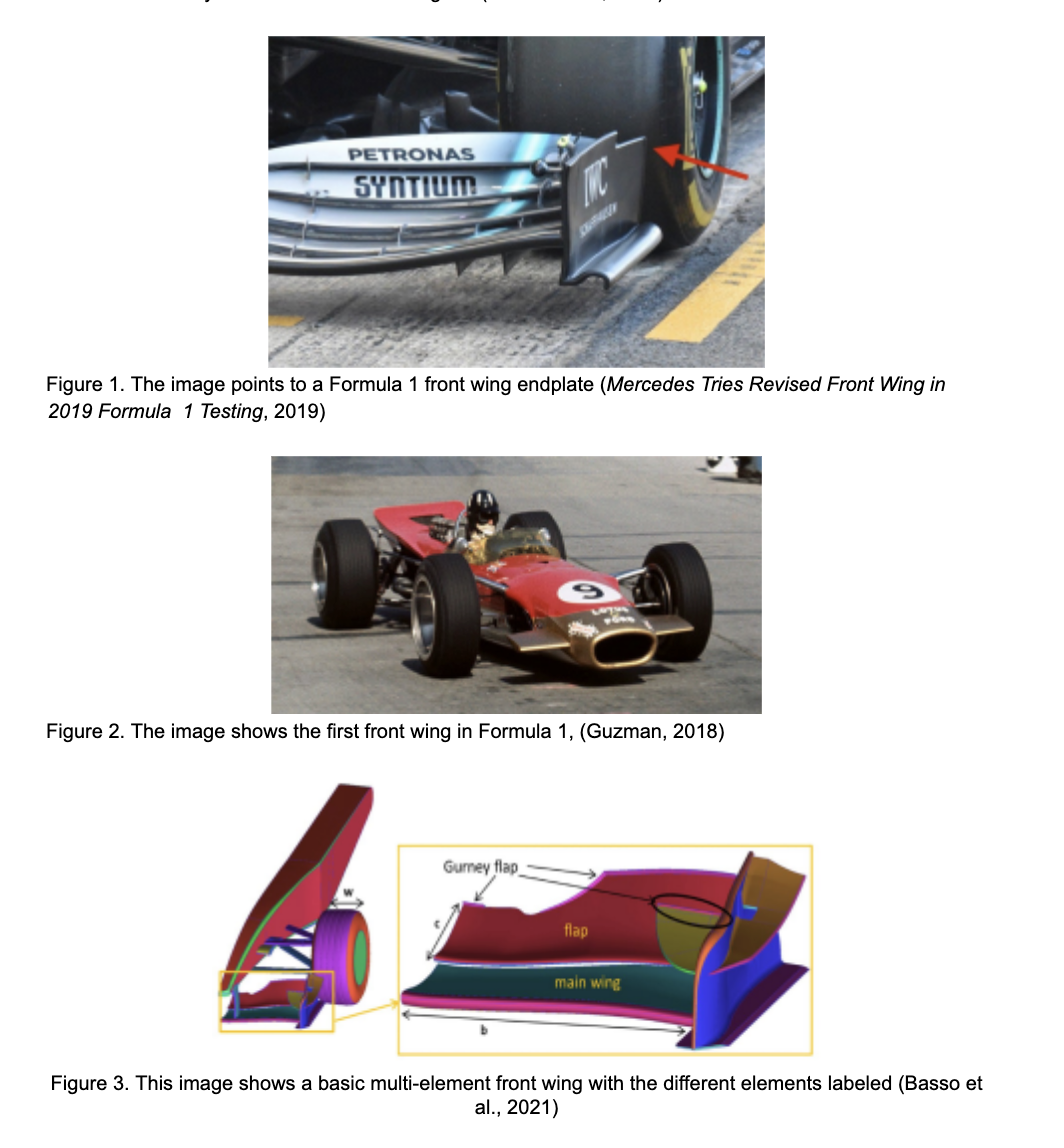
The first Formula 1 wings were not always as complex and effective as today. The first front wing utilized was at the 1962 Monaco Grand Prix on Graham Hill's Lotus. The design was unlike the modern front wing, which has multiple panels, as this wing consisted of a single panel. This slight adjustment had a major impact on performance, starting a revolution in aerodynamic technology. The subsequent addition of endplates to a wing demonsrates the constant evolution and innovation within the sport. Later, the concept of multi-plane wings, where a wing has multiple overlapping or connecting sections, was developed. Therefore, it is clear that front wings have a fascinating history and have continued to modernize the way Formula 1 cars are designed (Nafría Durán, 2022).
Although front wings have been studied extensively from a historical perspective within the sport of Formula 1, there appears to be a lack of research as to the implications of adapting a Formula 1 front wing to a road car. This gap of knowledge is important as using Formula 1 front wing designs on the everyday streetcar might bring the wide spread issue of fuel loss due to aerodynamic inefficiency to an end. The possibility of a Formula 1 front wing reme dying the issue of fuel loss due to aerodynamic inefficiency provides hope through previous studies on aerodynamic adaptations to cars. One study (Rose, 1981), shows the benefits of aerodynamic components on a typical truck. This truck was aerodynamically inefficient; however, through its modification with two unnamed proprietary aerodynamic devices, it saw a 36% reduction in its drag coefficient. Although this number may not seem significant, it results in a 16% fuel saving at a steady speed of just under 50 mph (Miles per hour), 80 km (Kilometers per hour), and a 13% fuel saving at speeds of just above 30 mph, 50 km. Despite implementing only one unnamed device, there was a fuel saving of around 13% under normal road conditions. Even though the unnamed aerodynamic modifications added did not include the specific device of a Formula 1 front wing, as the parts implemented were proprietary, it nonetheless proves that there needs to be more research regarding the possible effects of aerodynamic components such as a Formula 1 front wing. This data was collected through the use of a wind tunnel.
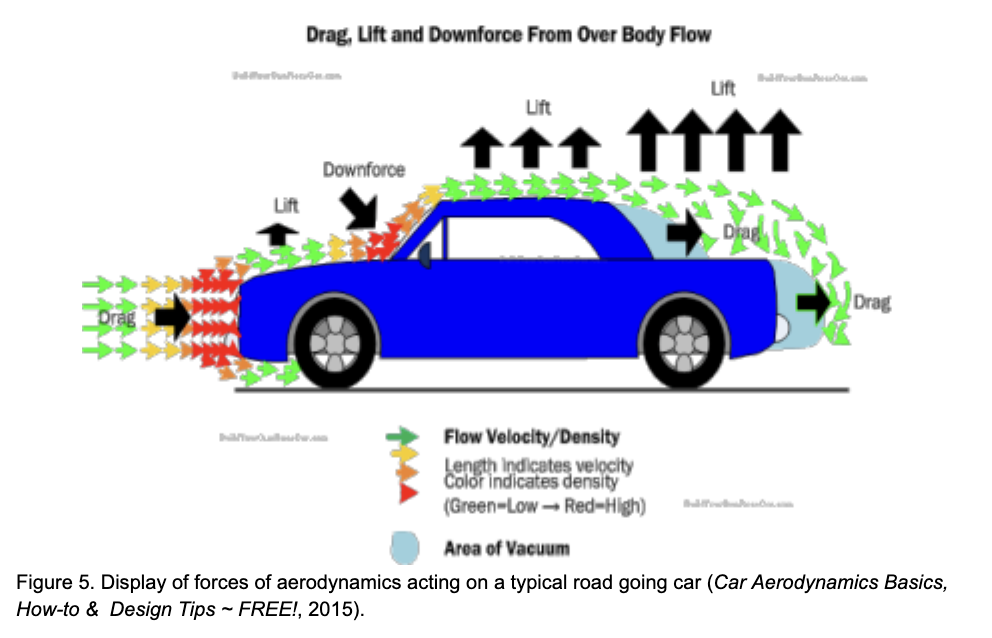
A wind tunnel is a device composed of 5 or 6 main parts, which allow for the most cost-effective approach for collecting data regarding aerodynamics when theoretical methods are inadequate. As a result, wind tunnels are used extensively in testing for things from cars to aircrafts. The wind tunnel in which automotive manufacturers and researchers - like those from the study above - test automobiles is called a closed-circuit wind tunnel; in this wind tunnel, the ducts are joined together. The parts that make up a closed-circuit wind tunnel are a turning section, a diffuser, a test section, the contraction, the flow conditioning and setting chamber, and the drive system. While the turning section may seem more self-explanatory, as the wind tunnel itself has a turn that connects both ends, the other parts may require some understanding. The diffuser is the part that decelerates the high-speed flow from the test section, thus allowing for static pressure to be recovered and to reduce the load on the drive system. The test section is an area that allows companies to place test models in along with any aerodynamic instruments to test those models. For example, a Formula 1 team would place a model Formula 1 car within this area along with an instrument such as a treadmill which can give the team data on the model car. The contraction acts as a funnel as it accelerates and aligns the wind flow into the test section, making it a critical component. The flow conditioning and setting chamber mini mizes flow decay and breaks up larger-scale flow unsteadiness. Lastly, the drive system generates a volume flow rate and compensates for pressure loss. This part determines how air moves through the test section (Cattafesta et al., 2010).
Although extensive testing of Formula 1 front wings has been done with Formula 1 cars, the testing of the front wing’s effect on a Toyota Corolla is a novel concept. The Toyota Corolla model is a logical car to test as it is the most popular car model in the world, according to its sales numbers (Ashraf, 2022). Not only is the Toyota Corolla the most popular car though, many sedan models have similar bodies and can therefore implicate similar results. Thus, the results can serve as base knowledge which would be beneficial to a plethora of people.
According to one of Toyota's official websites, the Toyota Corolla has a drag coefficient (the amount of drag the car has when moving through the air) of 0.29 (Toyota Corolla Reviews Ithaca NY | Maguire Toyota, n.d.). Sup plementary to this, a research paper (Banuri et al., 2020), which studied a 1:37 model of a Toyota Corolla, states that after testing their model in a wind tunnel, a drag coefficient of 0.265 was recorded. Although the two sources give different amounts, the difference can be explained through the research paper using a model based on the 2014 edition of the car while the website uses a newer model. Nonetheless, the sources give a basis for the vehicle's drag without any modifications, thus allowing for a key reference point for a crucial part of the experiment. Moreover, wind tunnels are just one of the ways to figure out and compile data. Computational Fluid Dynamics (CFD) uses numerical analysis and data structures to analyze issues that involve fluid flows, like air. In the car industry, this can be replicated by placing a 3D model car into software to view how fluids move around it, thus resulting in factors such as how much drag a car has and which areas of the car cause the most of it.
Furthermore, researchers can set up specific parameters and conditions for their model, like the air's density, momentum, and the speed at which the air is moving. Based on the factors set, various images showing the models facing these factors, along with data such as that previously mentioned of drag, will be provided to the research. Therefore, this is an essential and cost-effective tool in designing and understanding automobiles (Shaikh, 2021).
Whether using a wind tunnel or a Computational Fluid Dynamic system, three vital aerodynamic forces act on a car being measured, according to one of the most successful Formula 1 teams: AMG Mercedes Petronas. First are side forces, or the lateral force acting on a car. The second is drag, or the longitudinal force acting on a car. Third is downforce, or the vertical force acting on a car (Feature: Downforce in Formula One, Explained, n.d.).To fully comprehend the role of a front wing and why it affects the car utilizing it, it is necessary to explore the forces of drag and downforce in more depth. Downforce is generated by air flowing over the car. When driving, increased downforce means increased adhesion, which leads to more grip, allowing cars to handle better turns. Meanwhile, drag is the force that opposes the direction of thrust of a vehicle.
The concern with adding a device like a front wing is that the car has too much downforce. This, in turn, may lead to aerodynamic inefficiency as it will create drag to the point that the benefits of the device are not considerable. This issue is less prevalent in Formula 1, since unlike everyday street cars, race cars do not only need straight-line speed but also cornering speed. Therefore, the decrease in straight-line speed through the increase of downforce and drag may be beneficial (Kshirsagar & Chopade, 2018).
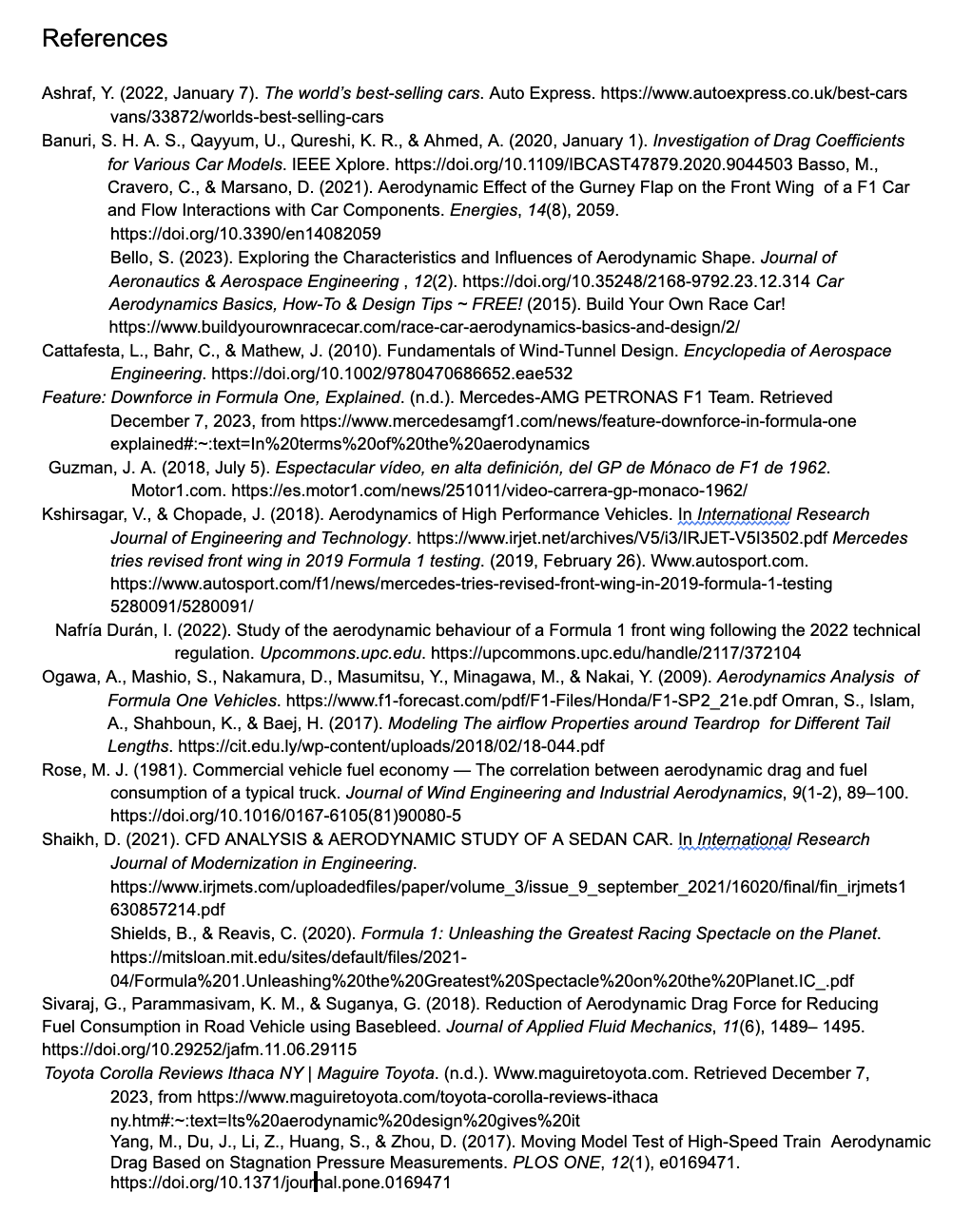
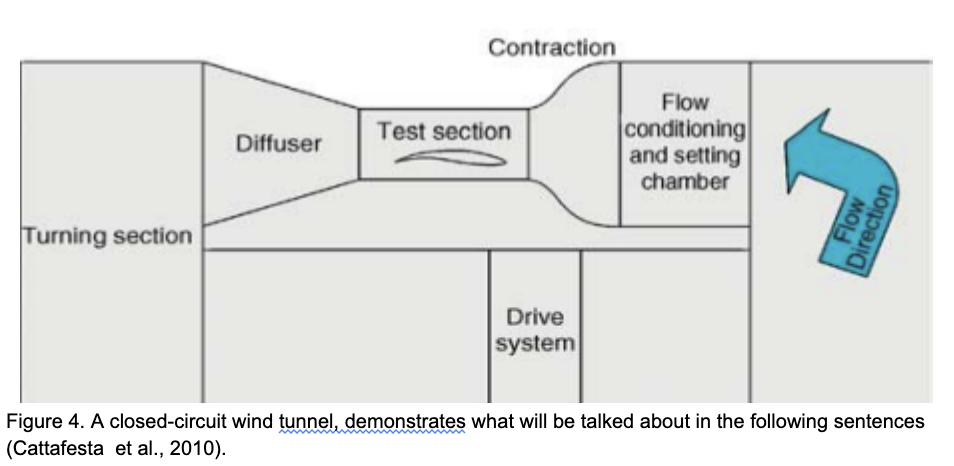
This understanding of the forces allows the role of a front wing to be more explicit, creating more downforce to allow the car to be faster throughout a lap. These increases and decreases in drag and downforce heavily result from changes in four main parts of a Formula 1 front wing. These parts are the main plane, the flaps, the endplates, and the dive planes. The main plane consists of the first flat panel on the wing. The main plane usually has a neutral angle of attack because it is the first element of a car to contact airflow. Furthermore, it is the closest part to the ground and it exploits this through the ground proximity effect, which is when it effectively leads airflow under the car. The flaps consist of the winged elements directly following the main plane, which have smaller dimensions than the main plane. The flaps are where the most front-wing aerodynamic downforce is created. In addition, the flaps can be adjusted for more or less drag and downforce based on the track or setup of the car. The endplates are the pieces on both sides of the front wing. Lastly, the dive plane is placed on the sides of the endplates to outwash flow over the wheels. When working in unison, these four parts allow a Formula 1 front wing to be the technological marvel it is and help the team gain a tremendous advantage in races (Nafría Durán, 2022).
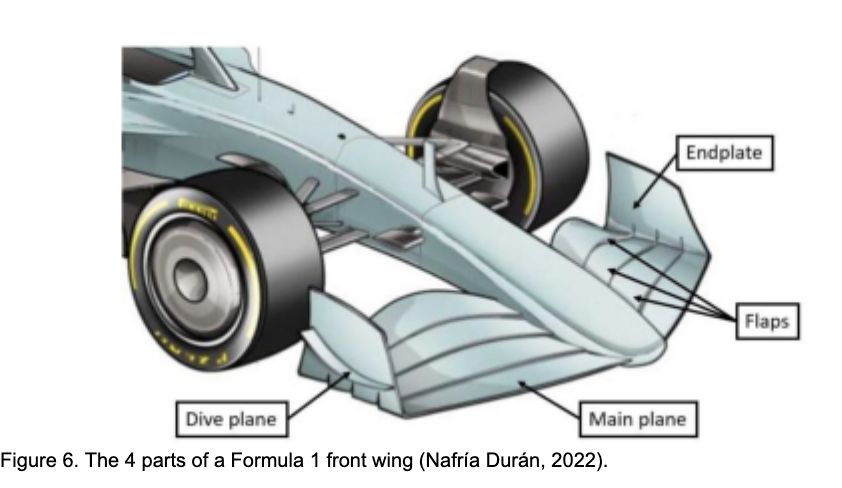
Will the same advantage witnessed in Motorsport be witnessed on the road? Due to the accumulated research, it is believed that the addition of a Formula 1 front wing to a Toyota Corolla will result in an improvement in aerody namic efficiency, thus resulting in an increase in fuel efficiency for the millions of people who buy Toyota Corollas every year (Ashraf, 2022). Furthermore, the hypothesis will be investigated in both a CFD system and in a wind tunnel.
Methods
Approach
To test the hypothesis, an experimental research study was designed to set up two parallel experiments that would allow quantitative data to be found to test if the addition of a Formula 1 front wing to a Toyota Corolla would decrease fuel efficiency by reducing drag. The first is a CFD, Computational Fluid Dynamics, experiment which would require the placement of a model of a Toyota Corolla with and without a Formula 1 front wing to see how the vehicle would be affected in a theoretical, simulated situation in regards to an increase or decrease in drag. The second experiment was a wind tunnel that could calculate the velocity of both the model car with and without a front wing. These experiments are undoubtedly the most suitable and standard methods in the field of car aerodynamics. Furthermore, by producing such standard experiments the validity of the research can be made certain.
Data Collection
First, locate a computer that could run the CFD program SimScale. Then, upload a CAD model of a car with and without a Formula 1 front wing. Next, run the tests on the software. After a certain amount of time, the software will provide the user with figures for the drag coefficient of each model.
After completing the first experiment it was time for the second. In this experiment, set up a large powerful fan, such as a leaf blower, or fans with high wind speeds. Next, get a white poster and mark a distance of 24 inches on it. Following that, set up a tablet with the app Playground Physics. Lastly, record each model car being pushed and import the video to Playground Physics, where the video will be processed and give all necessary data regarding velocity.
Analysis
Before analyzing the data it was easy to prepare as a result of the software used. For example, the CFD software automatically prepares the data regarding the drag coefficient for me. Furthermore, the app Playground Physics, which was used for velocity calculations, provides data and charts. Therefore, all that was required was transferring the information, such as velocity charts, spreadsheets, and distance metrics from the software to Excel to analyze the data. Furthermore, prediction errors were minimized by using the same wind tunnel, model car, surface, fan speed, and distance. In essence, before collecting the data and preparing it, all possible causes for outlying results were removed.
Methodological Choices
Although the approach of performing a CFD simulation and wind tunnel test may seem unnecessary for a project, after evaluations of the possible approaches, the combination was necessary for the results to be as close to accurate as possible. Through the use of both experiments possible human errors were able to be minimized to as minimal as seemingly possible. Wind tunnels are undoubtedly an essential and cost-effective tool in designing and understanding automobiles, thus it seemed logical to implement the same system which is so beneficial to major car manufacturers (Shaikh, 2021). With trying to be as comparable to real life, some may question the use of such an odd variation of a wind tunnel, differing heavily as it isn’t a large system with 5 or 6 main parts like the common wind tunnels used for cars (Cattafesta et al., 2010). However, the simplicity was important as it would allow the experiment to be easily reproduced. Therefore, the methodological choices may have some limitations but it seems to be the perfect blend of industry-standard methods with widespread materials to address the issue of aerodynamic efficiency which plagues cars and causes fuel loss.
Analysis
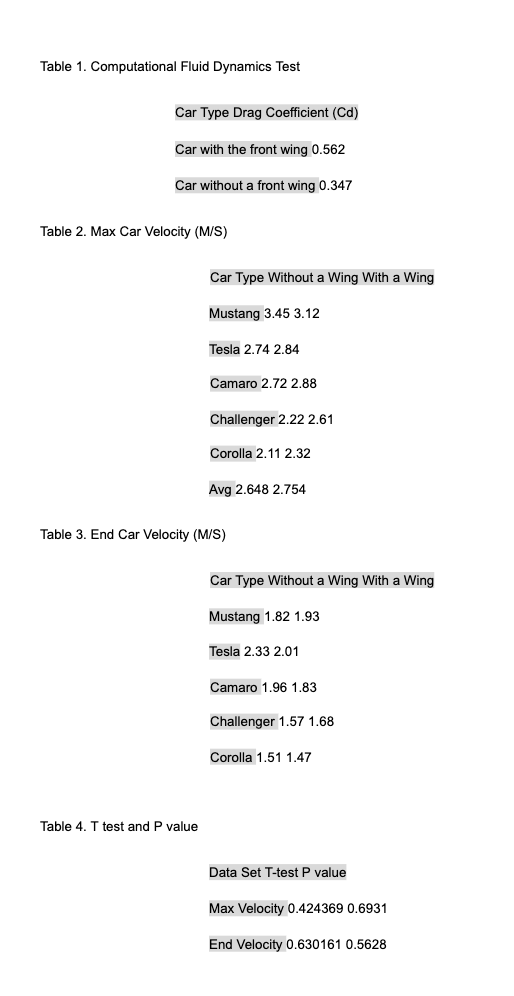
After completing the two tests described in the methods section the following results were obtained. First, following the Computational Fluid Dynamics test on computing software, the model car with the Formula 1 front wing achieved a drag coefficient of 0.562 while the model car without a Formula 1 front wing achieved a drag coefficient of 0.347. These results mean that the model car without the front wing had less drag, meaning more fuel efficiency. Following this, the wind tunnel testing was then performed on five different model cars (a Mustang, Tesla, Camaro, Challenger, and Corolla). Furthermore, the wind tunnel test led to two different tables (Tables 2 and 3), one for the max velocity and the other for the cars’ end velocity. The max velocity data showed that on average the cars using a front wing had a higher max velocity than the cars without a front wing, 2.754 mps and 2.648 mps respectively. This data indicates that cars had increased drag, and less fuel efficiency when using a front wing. However, this data regarding max velocity wasn’t without outliers. The second table (Table 3) which shows the end cars’ velocities obtained from the wind tunnel illustrates that cars usually had a higher end velocity while not using a front wing. This signifies that when the cars were in motion and not using a front wing they had more drag, and less fuel efficiency. Lastly, the T test and p < .02 (p value) from both Tables 2 and 3 were calculated. When a p < .02 is calculated it is widely accepted that a value of 0.05 or less means that the null hypothesis can be rejected, meaning your data is significant. Therefore, the p < .02s of 0.6931 and 0.5628 (for max and end velocities, respectively) show that there isn’t much statistical significance from the data collected.
Discussion and Conclusion
The experiments performed had the objective of determining whether the same benefits witnessed in Motorsport through adding a front wing would be observed in roadgoing cars. More specifically, whether a Formula 1 front wing would make a Toyota Corolla more fuel efficient by improving its aerodynamic efficiency. The answer to the more specific question is sometimes. The data shows a higher max but lower end velocity for the car when using a Formula 1 front wing, meaning that the addition makes the vehicle less efficient unless it is in movement. However, the data also highlights that the more general question, of whether it could help roadgoing cars, is applicable in certain situations. It was shown that cars with more boxy shapes did have a general improvement. This is logical because of the cone shape of the front wing. This cone shape makes a taper-like shape, an ideal frontal shape for making cars aero dynamically efficient (Bello, 2023). Thus, it firstly is logical to improve boxy cars by transforming their front end from one that is box-like to one that more similarly represents a tapered shape. Secondly, it logically improves these certain cars as it transforms the entire shape of the car. It makes a more round contact point in the front. This results in the car more similarly representing a teardrop shape, the most aerodynamically efficient shape possible (Omran et al., 2017).
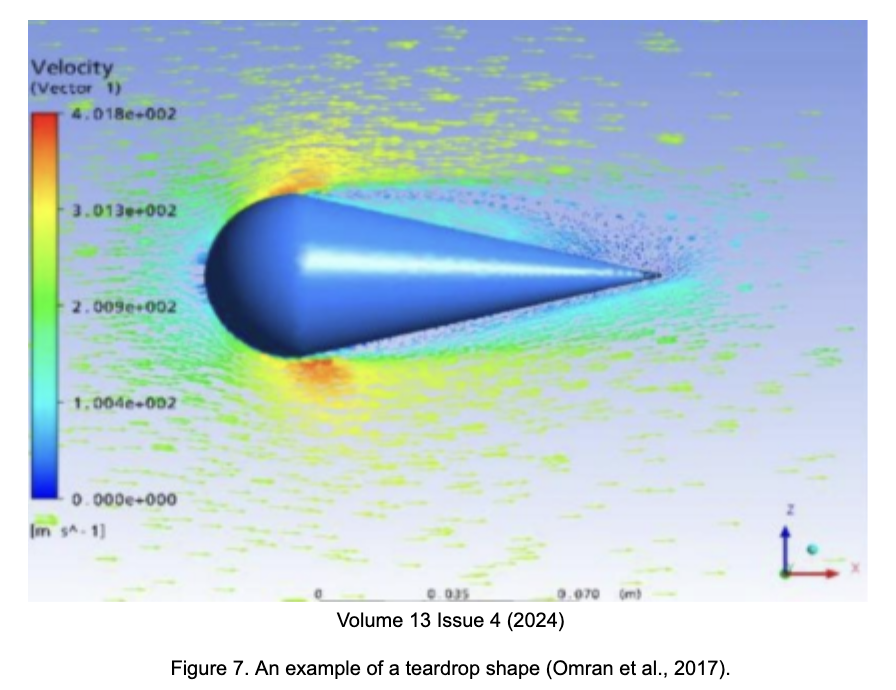
Although not a perfect teardrop-like shape is created, the addition of the front wing clearly allows for a more round tip at the front end of the car. However, for cars with already circular front ends the front wing works to block the flow of that shape. Thus, it reduces the car's aerodynamic efficiency.
The explanation provided fits perfectly with the consensus of the scientific community regarding aerody namic shapes (Omran et al., 2017). Furthermore, it explains why the hypothesis is wrong, as a Toyota Corolla could be classified as a car with an already circular front end which would only be impaired by the addition of the front wing. This is upheld by the data collected through the CFD test as it showed that the model car with a front wing had a higher drag coefficient value. This data is significant as a CFD test is extremely accurate due to eliminating human error by the computer doing all necessary computations..
Despite the collected information, the results of the Toyota Corolla model car maintains that a different in terpretation is possible. This is because the Toyota Corolla experienced less drag when in movement using the front wing even though it had a naturally circular front end. Thus, a new interpretation of the data of cars with an already circular front end seeing improvement shows a modified perspective on the former prevailing opinion that a front wing would likely not help a street car. The reasoning behind this is that a race car achieves quicker lap times through a combination of being fast in a straight line and when cornering. Front wings, along with other aerodynamic devices, set out to debilitate a car's straight-line speed as little as possible while improving its cornering speed as much as possible. However, for a road-going car, the ability to take corners at higher speeds is close to useless as a car is driving on the street and not on a race track. Thus, it is the consensual understanding by the scientific and aerodynamic community that adding a Formula 1 front wing would only impair the drag of a road-going car, especially in a scenario where that car has a circular front end and when the vehicle is moving in a straight line (Kshirsagar & Chopade, 2018). Despite that, the data from the experiment shows that a majority of the model cars, even those with circular front ends, had less drag when moving in a straight line. Under current knowledge though, the data shows that the model cars didn’t see improvement when they first started moving as they had higher max velocities. This means that based on the data collected cars with front wings would have less aerodynamic efficiency when first moving but become more efficient once in movement.
Through the information that was deducted the importance of these tests is highlighted. Furthermore, it ex plains the necessity behind finding certain factors within them, such as max velocity and end velocity as they allowed for certain interpretations. Aside from the wind tunnel testing, the CFD testing proved instrumental as it showed how the experiment followed standards from experts in the field and how much of the data gathered was logical under standards from experts in the field of aerodynamics (Kshirsagar & Chopade, 2018). Although success was seen in the CFD testing the same couldn’t be said for the wind tunnel tests. The p<.02s (p values) received from running T-test on max and end velocities. The values from this are important as they demonstrate statistical significance in an exper iment. The values received demonstrated that the data from the wind tunnel isn’t statistically significant, meaning that the data could be a result of chance or external factors.
Although the hypothesis was proven wrong, and the experiment's statistical significance is low, new infor mation was still uncovered in regards to the topic of aerodynamic innovations from Motorsport improving the fuel efficiency of road-going cars. For instance, a car having less drag once in movement through the help of the front wing. It is clear that there is still much to learn on the topic.
Certain limitations that may have hindered results in this experiment were present. One of the most evident restrictions was the limited sample size. Although the sample size was sufficient enough to show patterns and show new possible interpretations in the field of aerodynamics it hindered the statistical certainty of the research. This hindrance was observed in the data through the p < .02s recorded. Aside from this, the samples themselves were a possible limitation. This is an issue of a large magnitude as it affects everyone who drives. Thus, the samples should have been an actual car or at least a larger size model to maintain higher accuracy. For example, Formula 1 teams and professional aerodynamicists use large models of the car they are studying (Banuri et al., 2020). Aside from samples and sample size, another limitation was the equipment used. Unlike a large, industrial-sized closed-circuit wind tunnel used by Formula 1 or car companies, a small simple wind tunnel was used. The normal closed-circuit wind tunnels allow air to be pushed at changing speeds and maintain wind flow steadiness (Cattafesta et al., 2010). Conversely, the simple wind tunnel used didn’t necessarily maintain flow steadiness and did not allow air to be pushed at changing speeds. This stems from the lack of a diffuser and drive system in the wind tunnel used, respectively. As a result, the fan speed was always constant which led to the wind speed being less powerful as the car moved the further the car got from the fan the less it would be hit by the wind it was pushing. In light of this, one of the former implications suggested by the data could be disproved. This implication is that the cars using front wings would have more aero dynamic efficiency once in movement than those not using a front wing. However drag is proportional to speed meaning, as a car increases speed its drag increases too (Yang et al., 2017). Yet, this wind tunnel would see speed decrease, signifying that it could not be certain that the front wing was necessarily improving aerodynamic efficiency for a car once it was in motion. One explanation for this is that the front wing is causing the model cars to have a lower velocity due to it increasing the weight of the vehicle. Furthermore, the increase in velocity that would have been witnessed as the vehicle had a larger surface area through the addition of the Formula 1 front wing may have become insufficient to account for the wing's weight once the model car moved far enough away from the fan. This is as previously mentioned, the fan’s force would be weaker the further away the model car was from it so the previous implication possibly was a result of a limitation of the experiment.
Undoubtedly, the experiments and data produced did not come without error, nonetheless, they still prove that there is a gap in the car industry’s understanding and that Motorsport could help assist with this issue. Consequently, the data implies that further research must be conducted. Primarily, further research could be conducted on the idea of an active aerodynamics system- a system that could be activated and deactivated by the operator of the vehicle. If the implication that the front wing allows for less drag could be proven statistically factual it would mean that a new system that could take advantage of this revelation should be invented. For example, an active aerodynamics system would allow the front wing to fold into the car when stuck in traffic but fold out when moving at higher speeds. An example of this system is seen in many luxury cars such as the Porsche 911 which has a small rear wing that goes up when the car is moving at high enough speeds but lowers when moving at lower speeds. Furthermore, this system would eliminate worries about how a front wing would affect the infrastructure around cars. For example, speed bumps would still be able to be used as the front wings would be able to retract and avoid hitting anything and the car would still be able to park normally without worry of damaging the wing. Aside from this, the research also showed how further research using CFD software can be beneficial as the software allows the unit of Cd (drag coefficient) to be easily found. This unit being universally used in partnership with CFD allowing it to be calculated with very limited errors would make future research in the area more widely applicable and understood. It is certain though, that these possible implications and ideas for the topic show that it might be required to look at the issue from an economic perspective. The question becomes whether the long-term economic benefits from this research which could poten tially make cars have a more expensive base price outweigh the short-term economic negatives of fuel costs.
Without a doubt, the research has significantly assisted in addressing the gap of knowledge regarding possible aerodynamic and fuel efficiency enhancements in Toyota Corollas and various other street cars through the addition of a Formula 1 front wing. Whilst filling this gap, the research and the possible implications it creates undoubtedly show that other gaps in this field remain unanswered and that it is of utmost importance that research continues.